A number of Japanese publishers, including Screwire Ennix, Vande Namong Palace and Cape Town, issued an open letter through the Japanese Content Overseas Circulation Promotion Agency (CODA) requiring OpenAI to stop using its creative works to train and generate AI tool Sora 2. The letter from CODA, an anti-piracy organization called for by the Ministry of Economy, Industry and Culture of Japan, made it clear that Sora 2 produced “mostly similar to original Japanese content or images”.
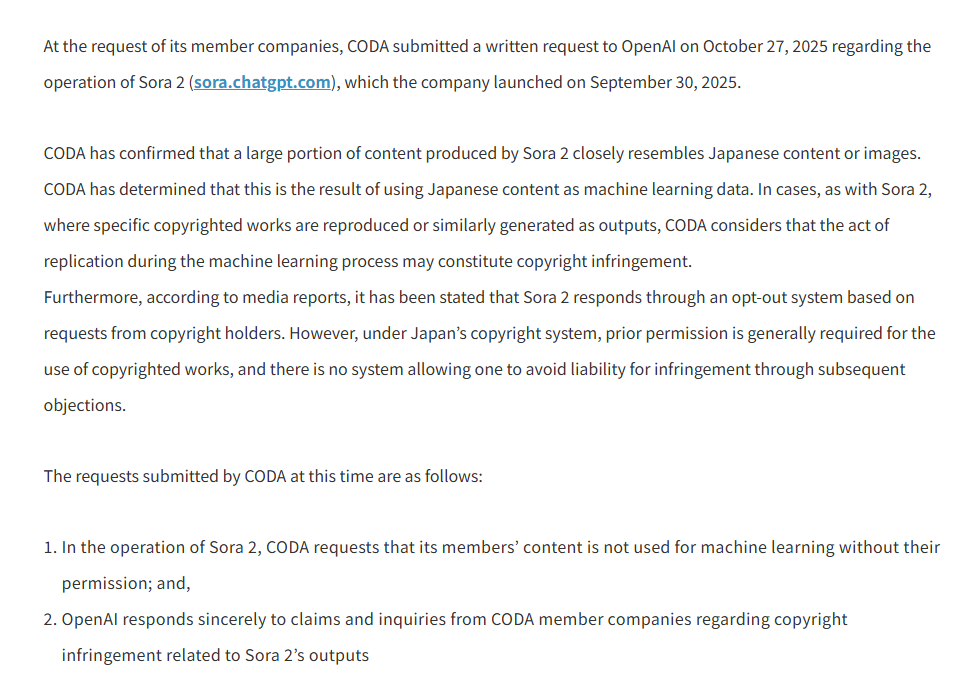
In its statement, CODA states: “It is confirmed that Sora 2 produces a large number of outputs that are highly similar to the original Japanese creation. We believe this is the result of using Japanese works as data for machine learning. When a particular copyright-protected work is copied or a similar content is generated, a local reproduction in the course of the machine’s study may constitute a copyright infringement.” The statement further stressed: “Despite media reports that Sora 2 uses an `opt-out’ mechanism based on the requirements of the copyrighted party, under the Japanese copyright system, the use of copyrighted works usually requires prior authorization and there is no system for exonerating tort liability through a posteriori challenge. ” CODA makes two demands: that the works of CODA members should not be used for machine learning without prior authorization; and that OpenAI should respond in good faith to copyright infringement claims and queries raised by member companies concerning the Sora 2 output. At the same time, the statement pointed out that the Sora 2 policy of “opt-out” was in conflict with Japanese copyright law, which implicitly continued to use copyrighted works and ceased only when expressly rejected.
As an important copyright protection organization in Japan, CODA is responsible for guaranteeing the legitimate global dissemination of Japanese video games, films, music, television and animation through anti-piracy operations. Its members include many well-known businesses such as Wanda Nammong Palace, Cygames, Dong Shing, and Schwire Ennix. CODA is one of the institutions that currently has serious copyright concerns about models such as Sora 2 and others. Earlier this year, the AI company Anthropic had agreed to pay $1.5 billion to settle a copyright action with a group of writers, and a large number of related proceedings are still ongoing. Last month, Nintendo issued a statement denying lobbying the Government of Japan on the issue of the creation of AI intellectual property protection. In contrast, Deep Sea Trek 2 and the Jedi Survival issuer Krafton are positioning themselves as “AI Priority Enterprises”. The Microsoft game CEO Phil Spencer recently stated that current AI applications focused on security and Xbox Live content audits and did not enforce their use in creative development processes.